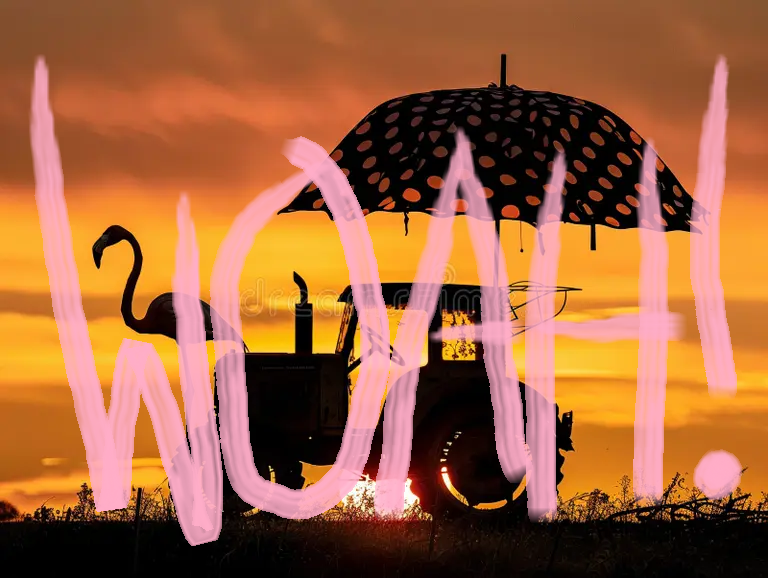
Adventurous Flamingo Tractors... CRAZY!!! flamingo
AFT is a very real organisation and this is a very real webpage.
have you ever thought about how flamingo is the opposite of freezingo
No one is quite sure who - or what - first decided that tractors should be flamingos. Some say it started as a joke in a coastal farming town where flamingos occasionally wandered inland and farmers were tired of pretending their lives were dull. Others insist it was a marketing stunt that went wrong and then somehow right. Whatever the truth, the flamingo tractors took on a personality of their own. They didn't just plough fields; they roamed, haunting the crop-laden corridors of a place some would otherwise call uninteresting. Once unnoticed; then revered. Perhaps out of fear, but undeniably with fervour.
These tractors were known for straying beyond the boundaries of farms. One would rumble past a wheat field at dawn and keep going, down a dirt road, across a bridge, and into places tractors were never meant to be. Where people were never meant to be. There are stories of a flamingo tractor reaching the edge of a marsh and stopping, as if remembering what it was assigned by fate to be. Those fools, who dare call themselves prophets, but cannot fathom the horrors that would befall even themselves. It resolved to be superior. Another supposedly climbed halfway up a rocky hill, engine coughing, before turning around, apparently satisfied. But we all know it wasn't. There is no such thing as satisfaction to a limitless being.
What made the flamingo tractors adventurous wasn't speed or power. They were not particularly fast, and they seemingly broke down as often as any simple automaton. It was their wanderlust. Farmers would leave one in a field overnight and find it facing the wrong direction in the morning, or parked beside a fence it had never been near before. No one could prove the tractors moved on their own, but no one could fully deny it either. As if to defy the nature of mortality, they persisted, unfettered by the futile boundaries of man, for what is a flamingo if not its own undoing?
People began to talk about them the way they talk about animals, not machines. “That one likes the coast,” someone would say. “This one's restless.” Children waved at them as they passed. Drivers slowed down on country roads, entranced. They became landmarks, then for the lack of stability, legends, then for the hope to forget, they disappeared off the face of the Earth, until we imagine them back.
In the end, the flamingo tractors didn't change farming or technology in any measurable way. No, the change they made was immeasurable, but infinite. Crops still grew at the same pace. Fields still needed tending. But they changed the world that people saw. They suggested, quietly and absurdly, with a cacophony of silence, that adventure didn't always belong to those with a mind to explore it. To let go, proclaimed the gods, is to allow another to reclaim. What is humanity, but another?